
The global construction industry stands as a significant player in CO2 emissions, contributing nearly 40% of the total. A bibliographical study in 2021 showed that the number of literature on biodegradability in building materials is significantly lower compared to the literature on the other material selection criteria that can promote circular economy – as shown in the figure below. In innovating for a building material alternative, this project aims to highlight: biodegradability, recovered content, ease of deconstruction, and reusability.

The B-Blocks Project
The B-Blocks project originated from a collaborative effort of academics of UPH Architecture and Indonesian bio-based material manufacturers. Starting in 2022, under the leadership of Fernisia R. Winnerdy, the “Appropriate Architecture Technology” class invited students to explore construction material alternatives. Partnering with MCYL – Mycotech Lab through Praktisi Mengajar, Kampus Merdeka, the class sought to experiment with their waste-based biodegradable material, Mycelium-Based Composite (MBC). The students were challenged to explore dry-stacking interlocking systems for the building blocks made with the material and how the design may also give additional values to the resulting wall configurations, for example how the wall can be curvy and flexible, and also allow air ventilation. the students came up with several design alternatives. The form made by student Josephine Valerie Sanjaya, B-Blocks, was selected due to its simplicity and ease of manufacturing.

T-Blocks (by Vallerine Aiko), N-Blocks (by Angeline Sie Prayangga), and B-Blocks (by Josephine Valerie Sanjaya)
The B-Blocks project aims to facilitate a paradigm shift towards regenerative construction practices. The project seeks to create a circular economy within the construction sector, where waste is minimized and resources are continuously cycled back into the environment. Unlike traditional materials, mycelium-based blocks can grow rapidly in a controlled environment using agricultural waste as their substrate. Its modular attributes grant architects and designers creative freedom, enabling rapid prototyping and efficient construction of temporary structures. This approach not only reduces the carbon footprint but also offers a biodegradable solution that decomposes at the end of its life cycle.

The project’s commitment to sustainability has been showcased through various academic conferences and exhibitions in 2023. Notable events include the 6th International Conference in Civil Engineering and Architecture in Bali, Indonesia (paper can be accessed here: https://link.springer.com/book/10.1007/978-981-97-5311-6), M-Bloc Design Week and Bintaro Design District, Jakarta, Indonesia, and Prototypes for Humanity and IDEO x Kyuhouse exhibition, during COP28, Dubai, UAE. Each presentation has not only garnered feedback and sparked constructive discussions, furthering the project’s impact and reach, but also allowed the team to reuse and test the different form compositions possibly made with the blocks.
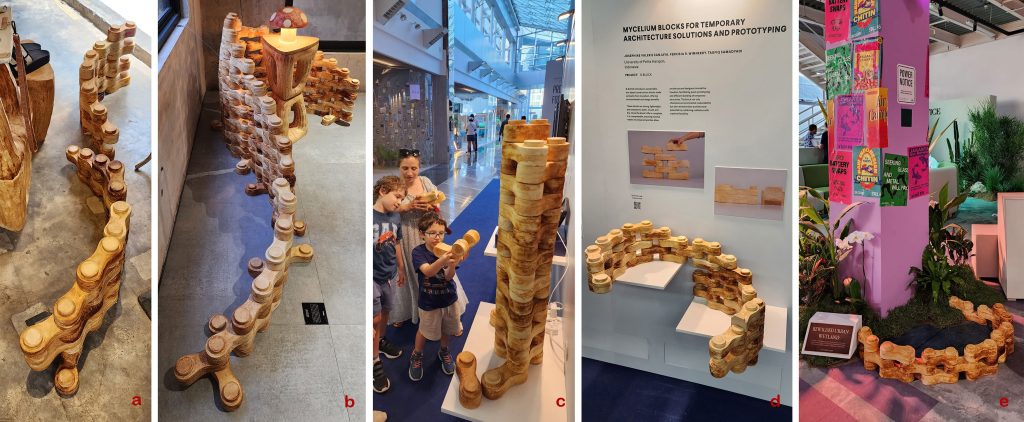
M-Bloc Design Week; Bintaro Design District, Jakarta, Indonesia; Prototypes for Humanity; and IDEO x Kyuhouse exhibition, during COP28, Dubai, UAE
Continuing Efforts
This year, 2024, UPH Architecture extends the research through Digital Innovative Technology class. Dani Hermawan and Jacky Thiodore, the lecturers, invited the next batch of students to interact, analyze, and innovate the form of these blocks. From the class we took two inputs regarding the form proportion: 1) to add distance between the two buttons and holes and, 2) to consider making not only 2-buttonhole B-Blocks. A number of new prototypes were made by MYCL-Mycotech Lab, with a plan to be presented at the 5th International Conference of Architecture and Material (ICAMC) at the University of Lisbon, Portugal, from October 15-18, 2024. This upcoming presentation will highlight recent discoveries and developments, reinforcing the project’s role in promoting sustainable construction practices.
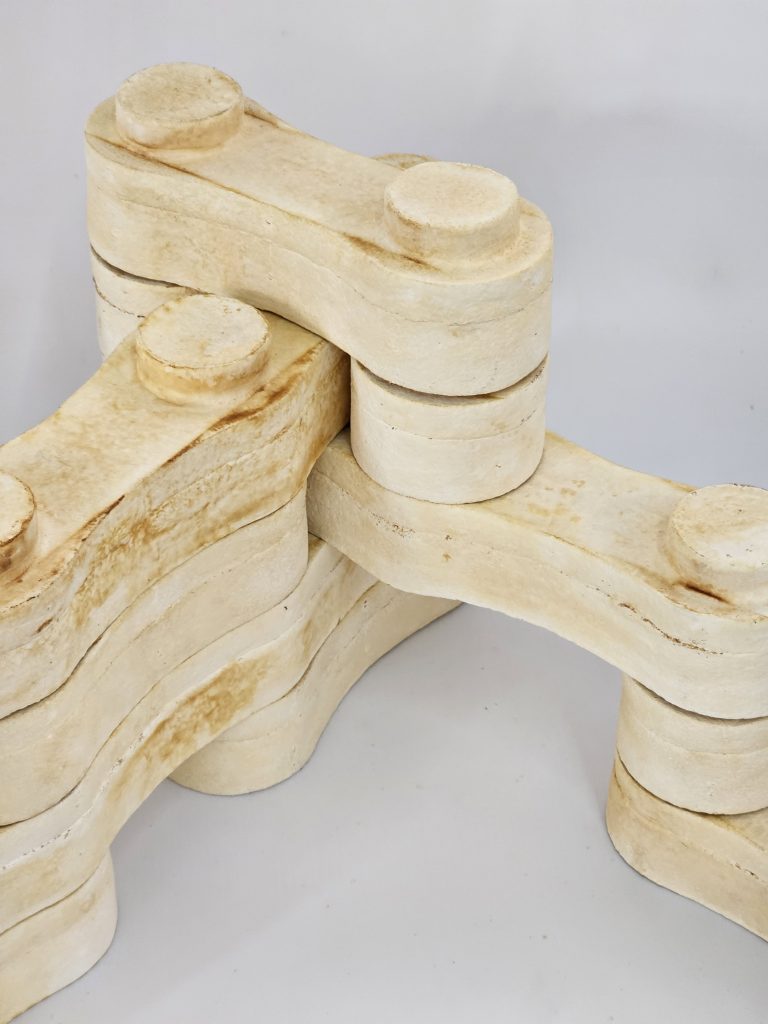
Since the production of MBC B-Blocks is still dependent on vacuum-formed plastic molds, further research is needed, first and foremost, to find a more eco-friendly and efficient method of manufacturing and how that new method will reciprocally affect the design of the blocks. Other than that we aim to invite people from different background studies to look into MBC B-Blocks and contribute their perspectives on challenges and solutions so as to improve this design initiative.
Up to this point, B-Blocks has proven its ease of deconstruction, reusability, durability, and flexibility to adapt to different settings to create unique configurations. As a biodegradable material, it has survived more than 5 exhibitions since its production in October 2023. This phenomenon shows that, despite the end game of these blocks to be a building material, at least MBC B-Blocks is a suitable medium to disseminate the idea of alternative materials, especially one that is grown (renewable), compostable, and reusable.

Team Members:
Academics & Practitioners:
Fernisia R. Winnerdy – UPH Architecture (initiator, lecturer, researcher: 2022-2024)
Adetania Pramanik – UPH Architecture (initiator, researcher: 2022-2024)
Mendy Laoda – UPH Product Design (initiator, researcher: 2022-2023)
Dani Hermawan – UPH Architecture (lecturer, researcher: 2023-2024)
Emanuel Agung W. – UPH Architecture (researcher: 2023)
Taufiq Samadyadi – MYCL (lecturer, manufacturer: 2022-2023)
Robbi Ilman Zidna – MYCL (manufacturer, co-researcher, 2023-2024)
Ronaldiaz Hartantyo – MYCL (manufacturer, co-researcher, 2023-2024)
Muhammad Yusuf Nurhadi – MYCL (manufacturer, co-researcher, 2023-2024)
Student Designers & Researchers:
Josephine Valerie Sanjaya (2022-2024)
Ricky Fernando (2024)
Edho Baron Mack (2024)
Others: Paulina Cynthia, Anthony Hamdani, Dave Derrian, Brian Matthew, Jonathan Mulya, Caroline Serlina, Yorendy Saputra (2024)